
Film Promoted by Emir Kusturica Channels Kremlin Disinformation on Ukraine
Hello. This is the second in a series of in-depth analyses I’m writing in partnership with the Western Balkans Anti-Disinformation Hub dealing with Emir Kusturica’s-backed documentary film titled “People of Christ – Our Time”, focusing on the Ukrainian Orthodox Church.
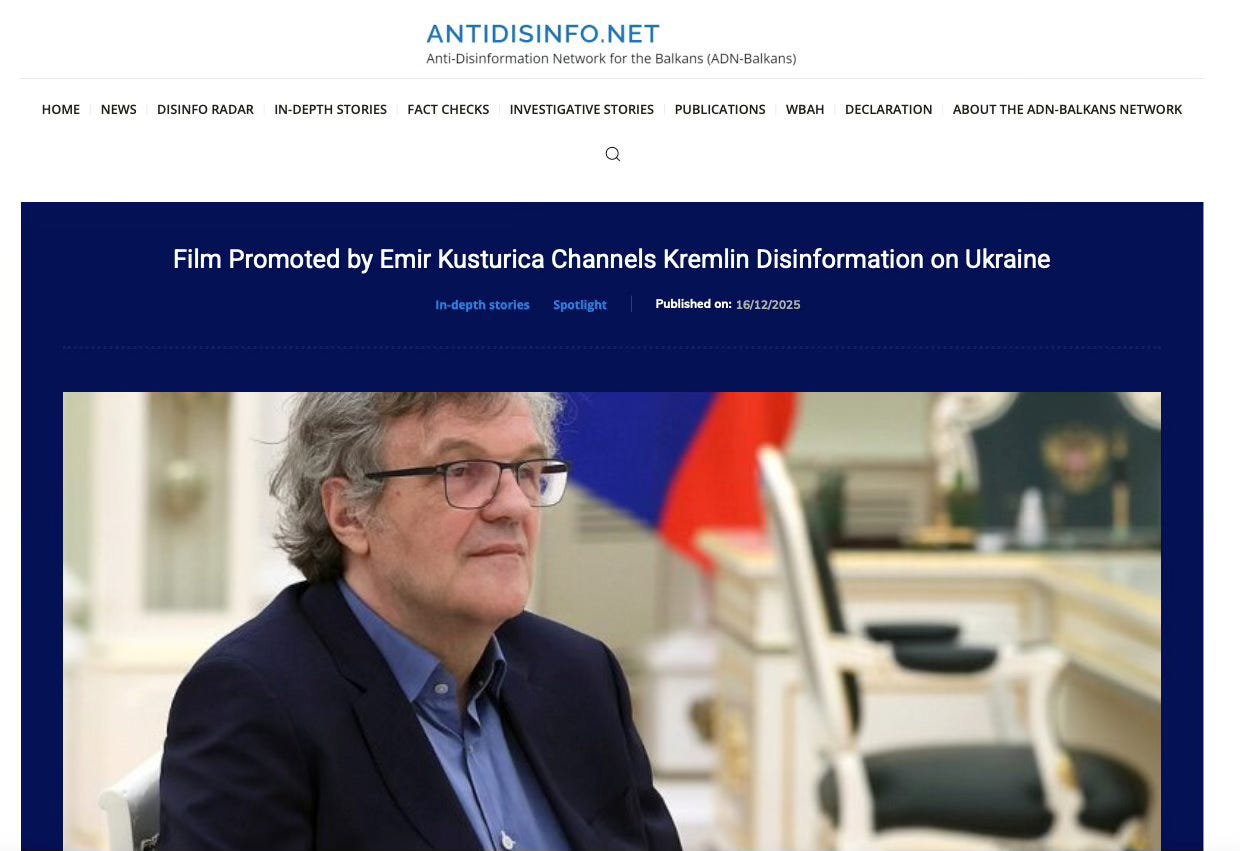
Russian disinformation narratives about Ukrainian faithful, presented and amplified in a pro-Kremlin documentary aimed at Western Balkans audiences, are being promoted by the region’s well-known film director Emir Kusturica.
The analysis was first published by Truthmeter and Antidisinfo.
Author: Dr Andreja Bogdanovski, Analyst
In a packed hall at Moscow’s Cathedral of Christ The Saviour last year, Russian Patriarch Kirill proclaimed Emir Kusturica “worthy”, calling out “Axios and Dostoin!” – traditional acclamations of church approval, moments after awarding him the Order of St Seraphim of Sarov, first class.
The award-winning Serbian film director flew to Moscow in December for the premiere of the film “People of Christ. Our Time” by screenwriter and director Jovan Marković, in which Kusturica also participates. The documentary is centred on Zelensky’s “obsession to destroy” the Ukrainian Orthodox Church, presented as the root cause of Russia’s criminal war and wrapped in layers of propaganda designed to cheer Putin’s conquest of Ukraine.
In Moscow, the newly decorated Serbian film director was seated next to the Patriarch Kirill and Russia’s First Deputy Prime Minister (now Defence Minister) Andrei Belousov, who read Putin’s message. In his congratulatory speech, Putin stated that thanks to “our Serbian friends” more people will learn about the “true causes” of the Ukraine conflict.
“No one can remain indifferent to the honest, first-person reflections on current events shared by priests, writers and poets, teachers, TV presenters and young people from different countries, such as Serbia and Italy, Russia and Ukraine.” Putin’s message read.
The screening of the film came only a week after the Patriarch of Moscow blasted the West for “cultural hegemony”, blaming “well-known external forces” working against the Russian World, which, according to him, represents “a cultural space of high spiritual and moral values”, defying state borders.
The film acts as an amplifier for well-known Russian disinformation narratives, both in political and religious aspects of the war, primarily serving the Kremlin, but also supporting Serbian ambitions in the Western Balkans. Most of the film promotes a view of a systemic, top-level persecution of the Ukrainian Orthodox Church while depicting the Russian church as a saviour.
The producer, Mirko Radenović, has drawn strong Balkan parallels, comparing Serbia and Kosovo to the situation in Ukraine, and evoking emotional memories of the 1990’s in the Balkans.
A controversial figure
Emir Kusturica has been a long-time supporter of Russia’s President Putin. Just days before the Russian full-scale invasion of Ukraine in February 2022, Russia’s Defence Minister Sergei Shoigu offered him the position of chief director at the Central Academic Theatre of the Russian Army in Moscow, an offer he initially accepted, but later declined.
“For me, Sergei Shoigu’s offer to become the chief director of the theatre is a great honour. The stage of the Theatre of the Russian Army has a great history and traditions,” Kusturica was quoted as saying, as reported by the press secretary of the Russian MoD.
His latest order of St. Seraphim of Sarov is not the first decoration he has received in Russia. Back in 2016, Putin decorated him with the “Order of Friendship”. A year later, he played with his band in Yalta in the Russian-occupied Crimea, vouching for the Russification of the peninsula, calling it a “natural, organic process.”
The Documentary
In a role akin to promoting a WW2-era propaganda, the launch of the documentary was taken up by a broad network of Russian state bodies, which spearheaded the rollout of the film globally. The use of Russian networks to promote the film has been evident across the board, from Russian (cultural) Centers to screenings organised by Russian embassies and consulates worldwide.
In the Balkans, the film’s original screening took place in Belgrade last September. The premiere in the Serbian capital gathered the top echelon of the Serbian Orthodox Church, including Patriarch Porfirije and Metropolitan Irinej of Bačka, featured in the documentary.
A subsequent screening of the film took place later in the year, with projections at a “RT.Doc: Time of Our Heroes” film festival organised by Russia’s top-propaganda channel, Russia Today (RT), alongside other films and roundtables. Russian war correspondents Alexander Sladkov and Semyon Pegov were also said to be participating in the event.
Orthodoxy is shown as dependent on Russia’s geopolitical success
The documentary opens with a rapid-fire montage of conspiratorial imagery: people in hazmat suits, biohazard signs, children being vaccinated, and clips from the Paris 2024 Olympic opening ceremony featuring drag performers. The sequence then shifts to America, showing the moment Donald Trump was shot in the ear at a campaign rally.
Central to the film for audiences in the Balkans is the interview with Serbian Metropolitan Irinej of Bačka, a powerful Serbian hierarch once tipped to become the new Patriarch. Irinej, who in April visited Vladimir Putin and Patriarch Kirill and described the Serbian year-long and student-led anti-government protests as a “coloured revolution”, speaks of Russia as the new Serbia and presents it as a wronged victim of Western interventionism.
He portrays Russia’s invasion of Ukraine as a defensive reaction to Western meddling and not an act of aggression against an independent country.
The just over one-hour film is intended to evoke emotional responses, such as anger and sadness, about the Orthodox divide in Ukraine. It tries to present the story from a human angle, portraying the tragedies caused by the division between Ukrainians and Russians as a rupture between two nations it depicts as “brotherly”.
Dr Natasia Kalajdziovski, a Senior Analyst at London security firm SecAlliance, says, emotions are central to the effectiveness of modern disinformation:
“Russian campaigns frequently engineer anger, fear, betrayal, or moral outrage to shape audience perceptions and behaviour.”
The examples with the ongoing church situation are “rated not simply to misinform but to trigger a fast, emotional response that short-circuits analytical thinking.”
She adds:
“Outrage is especially potent: it encourages rapid sharing, reinforces group identity, and deepens existing grievances – making it an ideal accelerant for influence operation.”
Irinej’s assertions
In the film, the Serbian bishop claims the current persecution of the Ukrainian Orthodox Church is comparable to, or worse than, that under Lenin and Stalin in the 1920s. Metropolitan Irinej also references NATO’s eastward enlargement, a long-standing story promoted by Moscow to justify the invasion.
“They once promised that they would not expand NATO to the East,” he said, before invoking his standing as a senior bishop and a close friend of Putin.
“I am personally sure that there would be no war between Russia and Ukraine if the West had not rejected any dialogue or agreements with Russia regarding possible NATO expansion to Russia’s borders and even to Moscow,” he stated.
Apart from repeating a well-known political propaganda narrative, the Serbian Metropolitan also employs apocalyptic religious themes. Similar to Patriarch Kirill, who described the war in Ukraine as a metaphysical struggle, he used the film to communicate a comparable message involving the containment of the Antichrist, aiming to frame the war in a quasi-religious context.
“You also need to know that there are deep spiritual processes behind this and that the ultimate struggle is between Christ and the Antichrist, between God and the devil, between good and evil, between light and darkness,” the Serbian bishop has said.
Irinej uses the words “aggressive and predatory” to describe the West. But according to him, “today we see that many people on many continents are rising up against this system after they were exploited, oppressed, and suppressed for centuries.” This mirrors a similar framing employed when examining Russia’s increased interest in the Global South.
The reaction towards Russia’s invasion of Ukraine across the Global South have been more muted, though, showing sympathy only in some cases, unlike the mostly clear condemnation emanating from Europe and North America.
Dr Kalajdziovski explains that while Russia’s disinformation strategy has kept the same goals since 2022, focused on undermining support for Ukraine, fracturing Western unity, and bolstering domestic legitimacy, it has evolved and “expanded its focus beyond Europe and the US to the Global South, where anti-colonial and anti-Western themes resonate.”
“Kremlin-linked networks push narratives portraying Russia as a champion of multipolarity and oppressed nations. Messaging stresses Western hypocrisy, the economic consequences of sanctions, and the idea that Ukraine is corrupt or unworthy of support,” she noted.
In 2023, at a forum in Vladivostok, Russia’s president famously said, Russia “had never been a coloniser anywhere”. He later declared the era of colonial rule over, stating that “the prosperity of the West has been achieved by robbing colonies for several centuries.”
As the war in Ukraine drags on, the film continues with screenings across the Balkans. It already had its premiere in Banja Luka (Republika Srpska – BiH) and it is said that it will be shown in Montenegro and North Macedonia as well.
With this extensive rollout, Russian disinformation narratives have taken their presence in the arts sector to a new level.
This article was developed in partnership with the regional initiative Western Balkans Anti-Disinformation Hub, implemented by the Metamorphosis Foundation with financial support from the Ministry of Foreign Affairs of the Kingdom of the Netherlands. The contents of the article are the responsibility of the authors and do not necessarily reflect the positions of the project partners and donor.
https://antidisinfo.net/


An excellent breakdown. Thank you.